
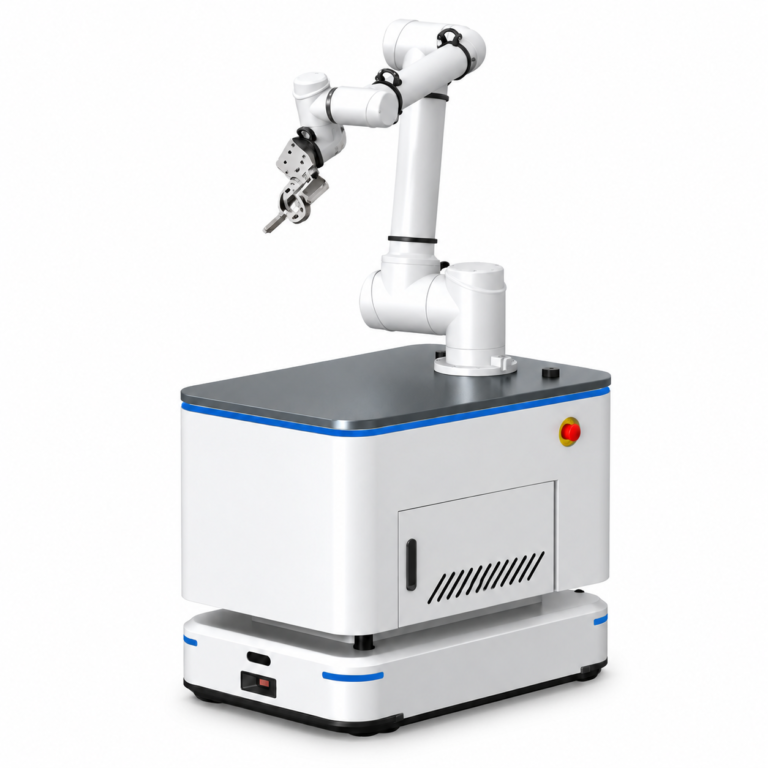
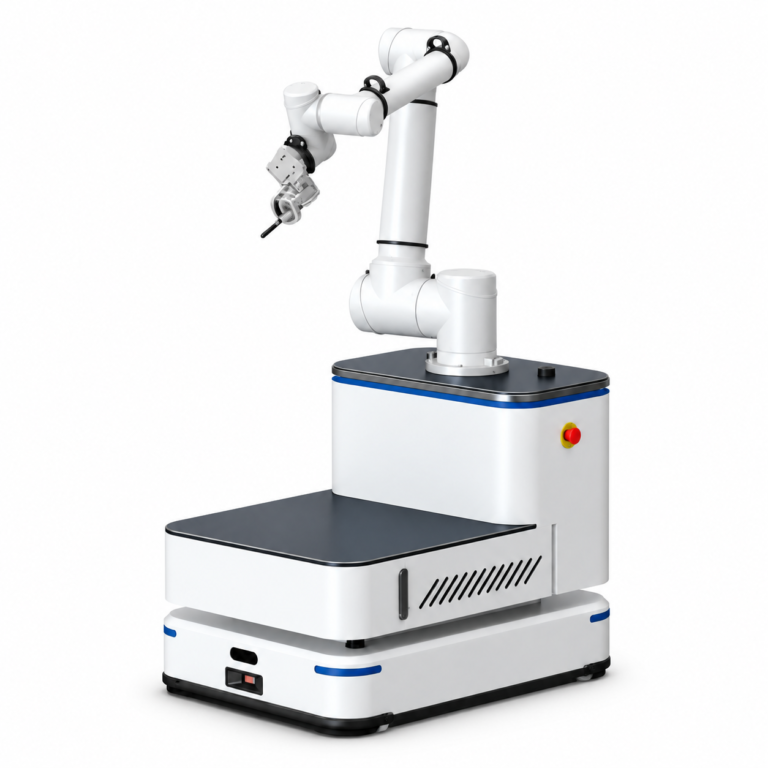
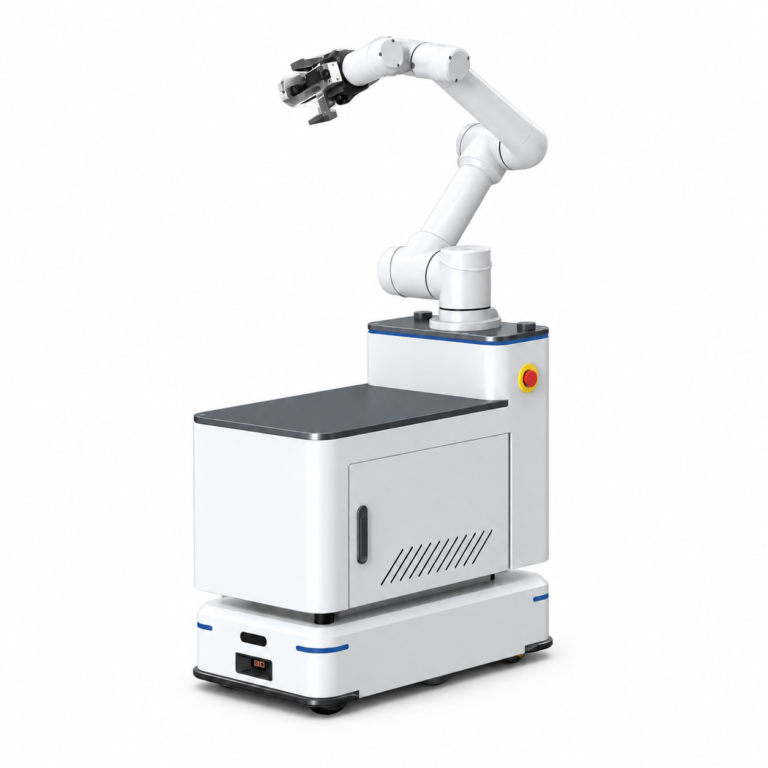
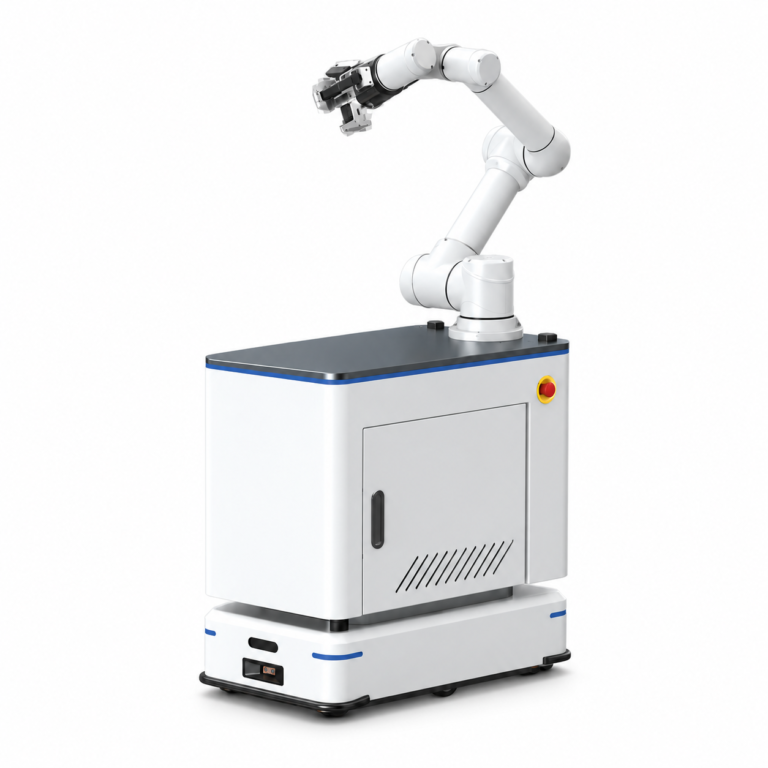
What is a mobile manipulator?
The base changes location; the arm changes the position and orientation of the item relative to the workstation. The end effector establishes contact with the load. Combining individually specified components does not establish the accuracy, stability or safety of the assembled platform.
The transfer task
Transport alone may leave manual work at the endpoint: retrieving a rack, opening access or presenting an item to a fixture. Manipulation can address a defined endpoint task, but each additional action creates reach, alignment, sensing and recovery requirements.
Transfer sequence
- Station requests an item
- Base reaches the work position
- Working position is verified
- Arm performs the agreed pickup
- Grip and transfer are confirmed
- Arm returns to a travel position
We agree the handoff signals, permitted movements and recovery steps with your integration team.
Application requirements
Instrument access, rack pickup and station-to-station workflows in which movement must be combined with a defined manipulation task. Each station needs a compatible approach and handoff.

Modules and interfaces
| Module | Function | Engineering input |
|---|---|---|
| Base-to-arm structure | Mounting plate, stiffening and mechanical reference | Review arm motion, static load and dynamic load cases with the OEM. |
| Arm and end effector | Reach, grip geometry, cable or hose routing | Actual container surfaces, tooling mass and recovery from failed pickup. |
| Station referencing | Dock, local sensing or other position reference | Base arrival error, fixture alignment and task tolerance budget. |
| Control and protective interfaces | Travel state, arm state, station permission and stopping | Define who controls each state and how conflicting commands are prevented. |
In-house manufacture and complete device integration
The mobile base and robotic arm are externally sourced. LabCarry manufactures the robot body, arm mounting structure, platforms, grippers, frames and other mechanical hardware in-house, using sheet metal fabrication and machining.
We integrate the base and arm hardware and firmware with the platform, complete the device connections and provide the agreed external interface. Assembly, mechanical alignment, calibration and hardware interface checks are included in the defined delivery scope.
The handover identifies the selected component configuration, supported functions and interface details. Your scheduling software connects to that platform interface; your team retains task scheduling, laboratory workflow logic and instrument coordination.
Connecting your scheduling software
LabCarry handles the hardware and firmware connections between the base, arm and platform devices. The customer software team connects at the external platform interface to request supported functions and read their status.
- Agree the device functions, commands, returned states and connection method before the build.
- Define the working position, permitted arm/base operating states and hardware interface checks for the selected configuration.
- Your team owns task priorities, laboratory workflows, instrument coordination and application-level exception recovery.
- Confirm which station fixtures are supplied by LabCarry and which instrument or facility interfaces belong to the customer project.
Platform interface acceptance and customer application acceptance are distinct checks. Both use the agreed hardware, firmware and interface configuration.
Operating conditions and verification
We select the arm against the required reach, payload and station geometry. A collaborative arm still needs an application-specific risk assessment when installed on a mobile platform; the complete assembly and intended movements must be verified.
How should the combined assembly be accepted?
Freeze the base, arm, tool, carrier and station configuration together for the acceptance build. Record the reference frames and the method used to establish them. An arm result measured on a fixed bench does not describe the complete mobile handling task.
| Acceptance question | Configuration detail to record | Observed result |
|---|---|---|
| Does the platform reach a usable station pose? | Station datum, docking method, base setup and the intended payload. | The measured condition at the start of manipulation, using the agreed method. |
| Can the tool acquire and retain the object? | Tool revision, object variants, gripping surfaces and sensing arrangement. | Pickup, retention and detection results for the defined test objects. |
| Can the system place and release it? | Target fixture, placement condition and receiving-station permission. | Physical placement and acknowledgement by the receiving system. |
| Can travel resume in the agreed configuration? | Approved travel posture, payload state and relevant interlocks. | Recorded transition from handling to the permitted travel state. |
For measurement background, NIST’s mobile manipulator research dataset describes measurements of a mobile base and onboard arm with an independent tracking reference. The study provides background on measurement methods for the combined base and arm.
What we need to review your project
- Arm and base models, configurations and supplied documentation.
- Tooling mass, item mass, gripping surfaces and container variability.
- Station drawings, working heights and allowable transfer error.
- Base-to-arm mounting interface and structural load cases.
- Interlocks between travel, arm movement and workstation access.
- Acceptance cycles including missed picks, lost signals and safe recovery.
Common questions
Is base docking accuracy the same as pickup accuracy?
No. Pickup performance also depends on arm positioning, tooling, structural movement, station references and the item itself. Specify a task-level acceptance method.
Can the arm move while the base travels?
Do not assume this operating mode. Define it explicitly and assess the complete system; a stationary manipulation sequence may be the chosen project arrangement.
Who chooses the robotic arm?
LabCarry sources and integrates the arm against the agreed task and configuration. Customers may specify a preferred model. Reach, load, mechanical fit and hardware/firmware interfaces are reviewed before the platform design is released.
Can one gripper handle all labware?
Only if the geometry, material, load and permitted contact areas are compatible with the agreed design. Mixed labware may require different tooling or fixtures.
What is needed to review the mounting assembly?
Provide base and arm interface drawings, assembly loads, cable requirements, service access and acceptance criteria. A photograph alone is insufficient.
Does mounting a collaborative arm certify the whole system?
No. Component documentation must be considered within the integrated application assessment. The installed platform and its intended tasks require their own verification.