
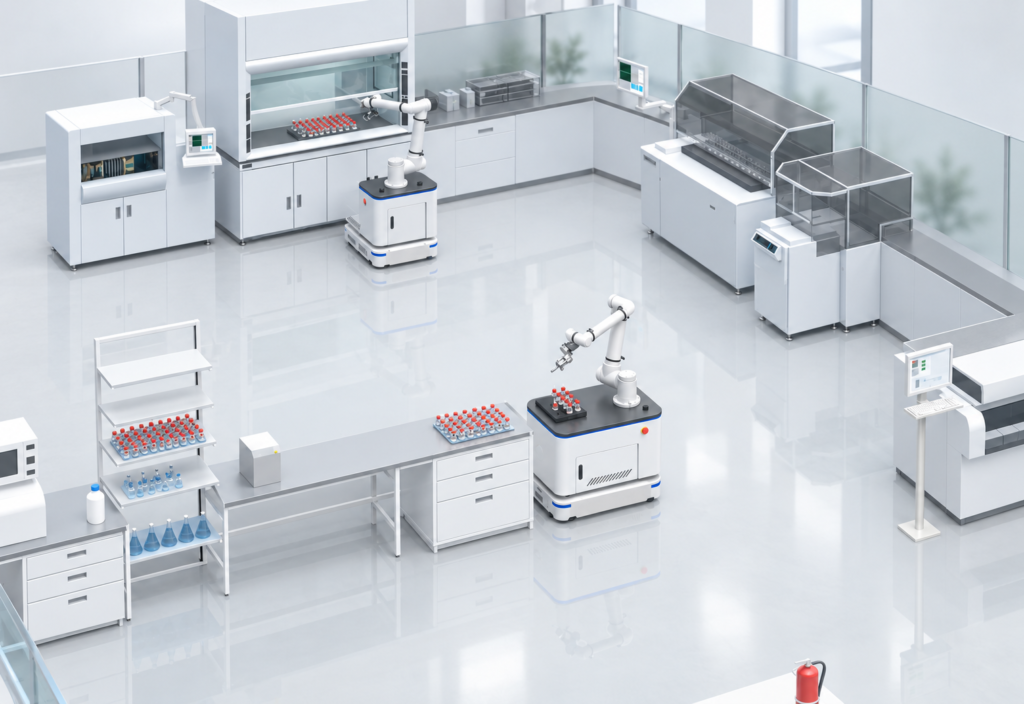
Workflow application
Pharmaceutical & biotechnology
Transfer requirement
Connect sample storage, preparation and analysis stations without assigning a person to every transfer. Batch preparation and shared instruments can create bursts of transport demand; the review should identify queues, time limits and the point at which custody changes.
Carriers and contents
Sealed sample tubes, covered labware and contained research materials, subject to the laboratory’s handling procedures.
Handoff requirements
Define carrier identity, dwell-time limits and the receiving station’s readiness signal. A mobile platform can move a rack; an arm or workstation mechanism is needed if individual vessels must be picked.
Transfer task
Transfer task: a closed carrier moves from a preparation area to an instrument loading point. Define whether receipt means arrival at a buffer or confirmed loading into the instrument, and which system records the carrier status.
Where mobile robotics may not be appropriate
Do not treat a transport robot as an aseptic process or validated pharmaceutical system. Product-contact handling, sterility and regulated workflow validation require a separate project assessment.
Continue with sample transport requirements.
Workflow application
Analytical & testing laboratories
Transfer requirement
Reduce walking between instruments while keeping each sample associated with the correct test request. A shared preparation area can serve several analysis queues. The useful question is how carriers are prioritized and where they wait when a receiving station is occupied.
Carriers and contents
Closed vials, tube racks and prepared specimens in suitable carriers.
Handoff requirements
Describe the preparation queue, instrument queue and storage destinations separately. Define what happens when an instrument is unavailable or a barcode cannot be read.
Transfer task
Transfer task: a prepared rack is dispatched to the next available analysis station. Agree how destination readiness is checked, how an occupied buffer is handled and whether a returned rack creates a separate task.
Where mobile robotics may not be appropriate
A transport robot cannot resolve inconsistent container geometry or a workstation with no accessible handoff. Sample residence time and instrument availability can remain the throughput constraints.
Continue with transfer states and exceptions.
Workflow application
Chemical & advanced materials laboratories
Transfer requirement
Move defined, closed containers between approved laboratory locations while limiting unnecessary manual carrying. Container compatibility, segregation and route restrictions can determine whether a proposed movement is suitable before transport frequency becomes relevant.
Carriers and contents
Only containers and contents specifically assessed for the route and intended handling. Provide substance identity, container closure and spill-response requirements.
Handoff requirements
Evaluate retention, secondary containment, center of gravity, cleaning methods and compatibility of exposed surfaces. Specify restrictions on shared routes and any segregated transfer requirements.
Transfer task
Transfer task: an approved closed container travels between designated laboratory work areas. Review the actual contents, closure and containment requirements before selecting a carrier or route; an open or hazardous load requires a separate suitability assessment.
Where mobile robotics may not be appropriate
If the application requires explosion protection, chemical resistance or containment, raise it before we select the platform. We cannot confirm a suitable configuration until the contents, exposure risks and required protective measures have been assessed.
Continue with container and retention design.
Workflow application
Clinical laboratories
Transfer requirement
Connect approved sample collection or sorting locations with a defined receiving workstation. Receiving points need an unambiguous association between the carrier and the intended workflow, particularly when routine and priority tasks share a route.
Carriers and contents
Closed specimen containers in approved secondary carriers; the laboratory must define containment and handling conditions.
Handoff requirements
Specify identity handoff, access permissions, temperature or transit-time constraints and procedures for a missing or rejected specimen. Avoid unnecessary patient information in robot mission messages.
Transfer task
Transfer task: an identified rack moves from reception to a defined processing buffer. Establish the owner of sample-level identity, priority rules and handling of an unmatched carrier. Arrival alone should not update the laboratory record to received.
Where mobile robotics may not be appropriate
Mobility hardware does not establish biological containment, diagnostic suitability or medical certification. Clinical workflow approval and site-specific verification are separate responsibilities.
Continue with carrier identification and handoff.
Workflow application
Materials science & quality laboratories
Transfer requirement
Move identifiable specimens between machining or preparation, conditioning and measurement workstations. Varied specimens and irregular batch sizes can require different inserts or loading rules, making carrier changeover part of the manufacturing definition.
Carriers and contents
Solid coupons, specimen trays and covered test samples with known dimensions and mass.
Handoff requirements
Define allowable orientation, surface-contact areas and shock sensitivity. For irregular samples, review dedicated fixtures and safe retrieval at both ends of the route.
Transfer task
Transfer task: a specimen tray moves between preparation and a measurement workstation. Define the allowed specimen envelope, orientation and supported mass distribution, then identify which tray variants require separate verification.
Where mobile robotics may not be appropriate
Hot, sharp, unstable or unrestrained specimens require dedicated handling measures. Mobile transport is a poor fit where unmodified equipment requires manual clamping or inaccessible loading.
Continue with platform and payload interfaces.
Workflow application
Cleanroom & controlled environments
Transfer requirement
Connect compatible process areas while reducing transfers that otherwise require repeated personnel entry. Boundary crossings, cleaning methods and material restrictions can limit a route even when the robot physically fits the aisle.
Carriers and contents
Closed carriers compatible with the area’s contamination-control and cleaning procedures.
Handoff requirements
Define zone boundaries, transfer methods, surface finishes, exposed lubricants, wheel contact, particle-release evaluation and permitted cleaning agents. Charging and maintenance locations also need review.
Transfer task
Transfer task: a carrier moves within one approved controlled area or to an agreed transfer boundary. Establish who qualifies materials, cleaning compatibility and the installed system for that environment. A route survey does not establish cleanroom qualification.
Where mobile robotics may not be appropriate
A low-profile enclosure or smooth panel does not establish a cleanroom class. Suitability requires evidence for the actual assembly, operating mode and facility conditions.
Continue with project-specific verification.
What should every facility review include?
- Release a defined carrier
- Confirm collection and identity
- Travel through approved areas
- Verify destination readiness
- Confirm physical handoff
- Record completion or an exception
- Doors, elevators, corridors and workstation access in the loaded configuration.
- Carrier and container mass, dimensions, orientation and retention.
- Docking position, transfer mechanism and the station-ready signal.
- Traceability level, event owner and exception-recovery process.
- Charging, network coverage, cleaning and maintenance arrangements.
- Acceptance responsibilities for manufacture and for the actual site.
What should an overseas OEM define before manufacturing?
Provide the product stage, route, carrier and station requirements, selected base and arm, software interface needs and planned quantities. LabCarry supplies the agreed hardware platform and device interfaces; the customer owns scheduling, instrument coordination and application workflow validation. We use those inputs to review the carrier, mechanical layout and hardware interfaces for your project.
Application questions
Can one platform be used in all six areas?
Do not assume this. Containers, environments, station interfaces and verification requirements differ. Each configuration needs its own review.
Does reduced personnel movement establish cleanroom suitability?
No. The installed equipment and operating mode require evidence against the area’s environmental requirements.
Who approves the handling of a specific sample or reagent?
The project must assign the responsible laboratory and engineering authorities and obtain the evidence required for the actual contents and workflow.