
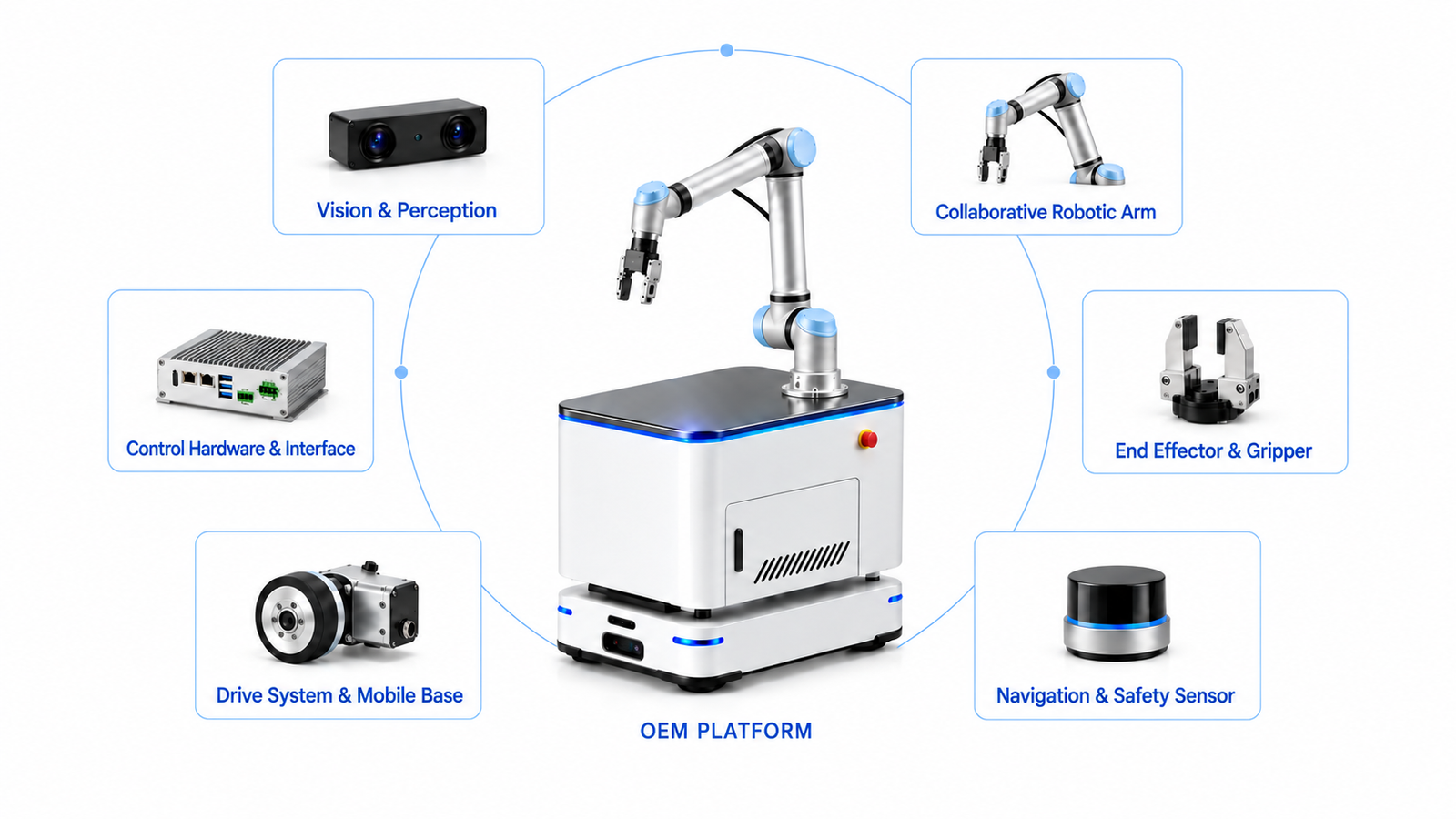
What LabCarry manufactures and integrates
Our core delivery is an integrated robot hardware platform. The mobile base and robotic arm come from specialist suppliers; LabCarry manufactures the surrounding mechanical hardware and completes the connections between the devices and the external platform interface.
| Work package | Responsibility | Delivery scope |
|---|---|---|
| Robot body and mechanical hardware | LabCarry | In-house sheet metal fabrication and machining for the body, platforms, grippers, racks, frames and fixtures. |
| Mobile base and robotic arm | Specialist suppliers; integrated by LabCarry | Externally sourced base and arm with their original hardware, controllers and firmware. |
| Device integration and platform interface | LabCarry | Base-to-arm hardware and firmware interoperability, device connections and the agreed external platform interface. |
| Assembly, calibration and hardware acceptance | LabCarry | Assembly, alignment, calibration and platform interface checks against the agreed configuration and acceptance criteria. |
| Scheduling and laboratory workflows | Customer | Task scheduling, workflow logic, instrument coordination and application-level recovery through the agreed platform interface. |
How your software connects to our hardware
The connection point is the robot hardware platform interface on the integrated body. LabCarry completes the underlying base, arm and hardware/firmware connections. Your team connects its scheduling software through the agreed interface to call supported device functions and receive their status.
At project definition, agree the supported functions, connection method, commands, returned states and behavior when communication is interrupted. Record the approved base, arm and firmware configuration. These details make the interface usable and testable for the customer software team.
The customer retains task scheduling, laboratory workflow logic, instrument coordination and application-level recovery. LabCarry remains responsible for the agreed device integration and hardware interface delivery.
| Order scope | LabCarry delivery | Customer input |
|---|---|---|
| Integrated robot hardware platform | In-house mechanical hardware, sourced base and arm integration, platform interfaces, assembly and calibration. | Handling task, software interface requirements, workstation dimensions and acceptance criteria. |
| Custom hardware or subassembly | Body panels, platforms, grippers, racks, frames or fixtures manufactured to the agreed drawings. | Mating interfaces, material requirements, quantities and part-level inspection criteria. |
| Repeat production | Builds to the released mechanical, component and interface configuration. | Approved changes, batch quantities and delivery requirements. |
From requirements to hardware handover
We agree the mechanical configuration and platform interface before releasing the build. Hardware acceptance covers the assembled platform and its agreed device functions; the customer then connects and verifies its scheduling software against that interface.
- Task and interface definition
- Base and arm selection
- In-house parts manufacturing
- Platform assembly
- Hardware / firmware integration
- Calibration and interface checks
- Agreed hardware acceptance
- Platform and document handover
What changes between a prototype and repeatable production?
A prototype shows that an arrangement can work. A production definition must also explain how another assembler builds the same configuration, how components are identified and how acceptance is checked. Record assembly-critical dimensions, cable routes, tightening requirements and alignment procedures that would otherwise remain in an engineer’s memory.
Before a pilot build, close the bill of materials and list unresolved design questions. Use pilot findings to update the drawings and instructions. An approved reference unit can help comparison, but it does not replace controlled documents. Expected annual quantity, batch size and component availability should be reviewed together before any delivery commitment.
Which quality and traceability records should travel with the build?
Agree the required record package before assembly starts. Depending on the project, this may include incoming inspection, assembly checks, component identification, serial-number records, inspection results, test reports and engineering changes. The required depth should follow product risk and the OEM’s service needs.
We agree how each unit will link to its build configuration and acceptance results. Your team can review the proposed record format with us before the build.
- Identify the unit, assembly revision and test configuration.
- Define who may approve substitutions and drawing changes.
- Define retention, access, release authority and the records delivered to the OEM.
How should confidential designs be handled?
We build hardware for your product and respect your customer relationships. We do not publish your name, drawings or identifiable project details without permission.
Start with a non-confidential scope summary. If the project needs an NDA, we arrange it before exchanging protected drawings. We also agree drawing access, permitted use, subcontractor access and ownership of tooling and designs.
What accompanies the hardware platform
Agree the handover package with your engineering team before the build. It should let your software team connect to the platform and your hardware team identify and maintain the delivered configuration.
- The as-built mechanical and component configuration, including the sourced base and arm.
- Platform connection details, supported functions, command and status definitions, and agreed interface checks.
- Relevant firmware and parameter versions, calibration information and hardware acceptance results.
- Assembly and service information, packing details and any reassembly checks included in the order.
- Named contacts for hardware support and customer-owned scheduling or application software.
What to send for an OEM project
- Your company type, product stage and intended application.
- The objects to move or grip, their dimensions, mass and contact surfaces.
- Workstation layouts, working heights, approach positions and platform envelope.
- Preferred or already selected base and arm models, if any.
- Your scheduling software interface requirements and the hardware functions it needs to call.
- Quantity, prototype or repeat-build requirements, target timing and agreed acceptance needs.
A non-confidential concept is enough for the first discussion. We can then identify the drawings, interface details and test inputs needed to define the build.
Common questions
Do you manufacture the robot body and mechanical parts yourselves?
Yes. LabCarry carries out sheet metal fabrication and machining for robot bodies, platforms, grippers and other mechanical hardware. Mobile bases and robotic arms are externally sourced and integrated by LabCarry.
Who connects the mobile base and robotic arm?
LabCarry completes their hardware and firmware interoperability, integrates the mechanical hardware and provides the agreed external platform interface.
Can we use our own scheduling software?
Yes. Your team connects its scheduling software through the agreed platform interface to call the supported hardware functions. The interface and configuration are defined for the project.
Does LabCarry develop our laboratory scheduling software?
Your team owns scheduling, task priorities, laboratory workflow logic and instrument coordination. LabCarry supplies the integrated hardware platform and its agreed device interfaces.
Can we specify the base or arm?
Tell us your preferred models and configuration. We review their mechanical, hardware and firmware interfaces against the required platform functions before confirming the build.
Can we order a hardware module separately?
Yes, the order can cover agreed body parts, platforms, grippers, racks, frames, fixtures or a hardware subassembly. Define the mating interfaces and acceptance criteria for that scope.